Midterm elections in the US are happening on November 3 this year. AI companies and associated individuals have spent more than $200M on this election cycle so far to promote the candidates they like1.
It is common practice in the US for industries to throw hundreds of millions of dollars into elections, with the goal of promoting candidates who’ll give them favorable regulations.
For the 2024 elections, the crypto industry spent $130M2, and was one of the largest spenders at the time. Dozens of crypto-friendly representatives and senators were elected, and the main Senate member who had been preventing pro-crypto bills from passing into law, got defeated 1.
A handful of AI investors and OpenAI’s president are now trying to replicate the strategy that led the crypto industry to obtain favorable regulations following the 2024 elections. In fact, some of the people behind crypto’s 2024 campaign are now backed by them to oppose candidates in favor of AI regulation.
In this post, I detail who is involved, what agenda they are pushing, and what tactics they use. Most of the things I explain here I learned while reading about the topic, I’m not very familiar with US politics. I tried my best to prevent mistakes and misunderstandings, but there might be some.
“A small group of some of the wealthiest AI investors in the world, who appear to be pushing for the rapid expansion of AI technology, have reportedly banded together to fund a network of political groups committed to electing candidates who want to keep AI largely unregulated”
What are midterm elections?
Midterm elections3 happen mid-way through the US Presidential term. The integrality of the House of Representatives will be elected, alongside one-third of the Senate. They’re important for the US President because a bad result for their party could prevent them from applying their program.
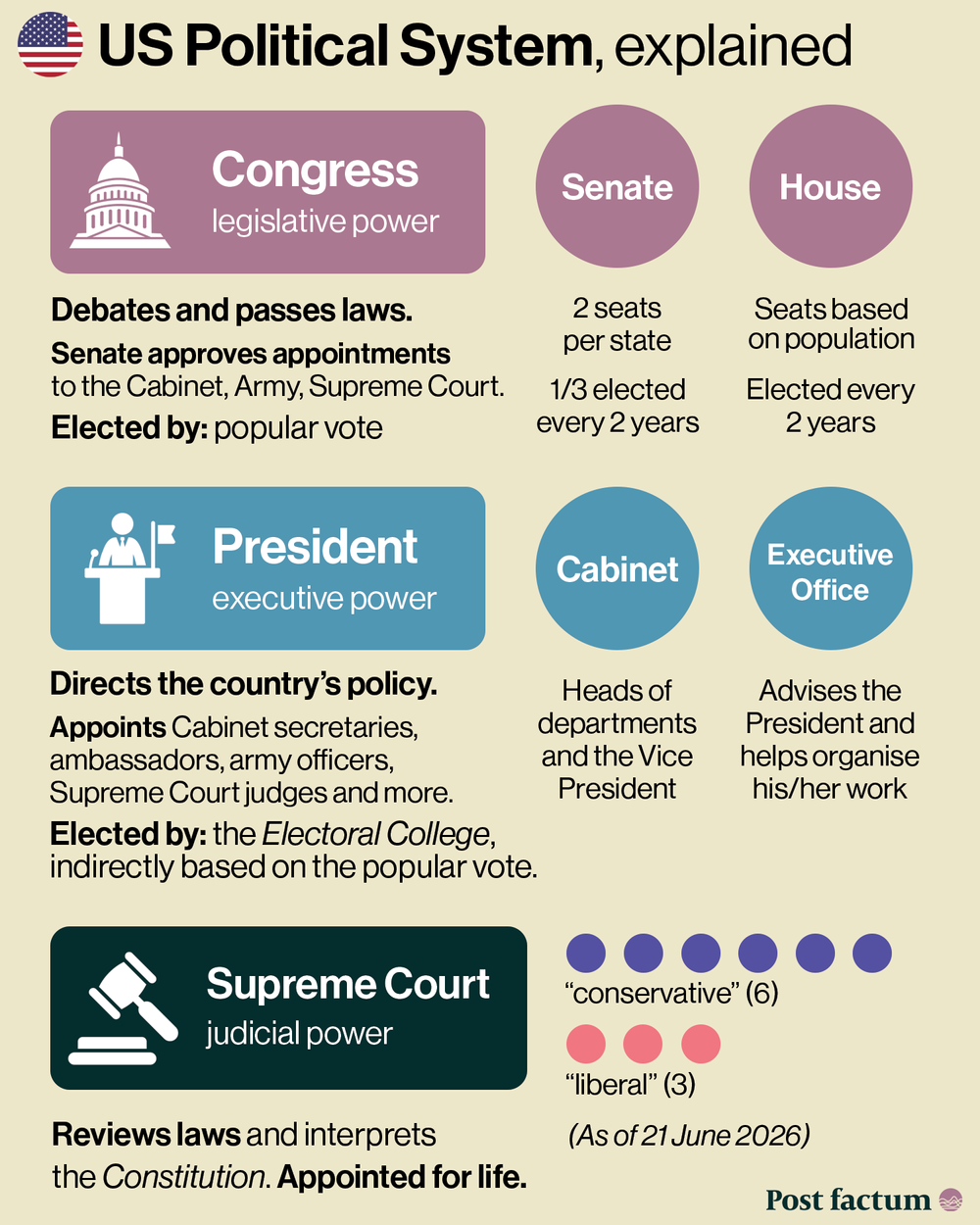
Figure: Congress is the branch of government that writes laws. It has two chambers: the Senate and the House of Representatives. Figure from postfactum.co.uk.
During the midterms, electors vote for one senator for their state (if their state has a Senate race that year), a House candidate for their congressional district (states are divided into districts), and various other state-level positions.
What does the Congress do?
The Congress proposes, debates, and eventually passes laws. A proposed law is called a bill, and it only becomes a law once both Congress chambers pass it and the president signs.
The Senate is one of the two chambers of Congress.
Bills are introduced by individual senators, and referred to a committee. For example, financial regulations are referred to the Senate Banking Committee, and there exist many more subject-matter committees. Committees can hold hearings, amend, and vote on whether to send the bill to the full Senate. Then the Senate votes on the bill. If it passes, the House must pass it too, and finally the President signs. Now the bill becomes a law.
Committees are sort of gates. If the chair refuses to schedule it, it’ll never move. Between 2021 and 2024, the chair of the Senate Banking Committee was Sherrod Brown. He was a crypto-skeptic, so “pro-crypto-legislation” was never sent to the Senate for vote. He was defeated in the 2024 elections (the crypto industry spent millions against him). That seat contributed to Republicans taking the Senate majority, and the majority party chose committee chairs (in 2024, the Republicans). So a pro-crypto senator became Banking Committee chair. After that, crypto bills advanced.
The House pretty much has the same function of proposing bills and voting on them, though the specifics are different.
How is AI money influencing the midterms?
To raise and spend money to influence elections, you need specific types of organizations that are called super PACs (for Political Action Committees). They were invented precisely for that purpose.
They have become very common and many different industries and groups of interest have created their own. Super PACs can’t directly contribute to candidates but they can fund independent expenditures, such as ads or campaigns to advocate for or against candidates. In this election cycle, we’ve seen many new super PACs emerging that either support anti-AI regulation candidates, or regulation-friendly candidates2.
Researcher Molly White built an amazing tool, Tech Influence Watch4, to track how much money the “AI super PACs” raise and spend.
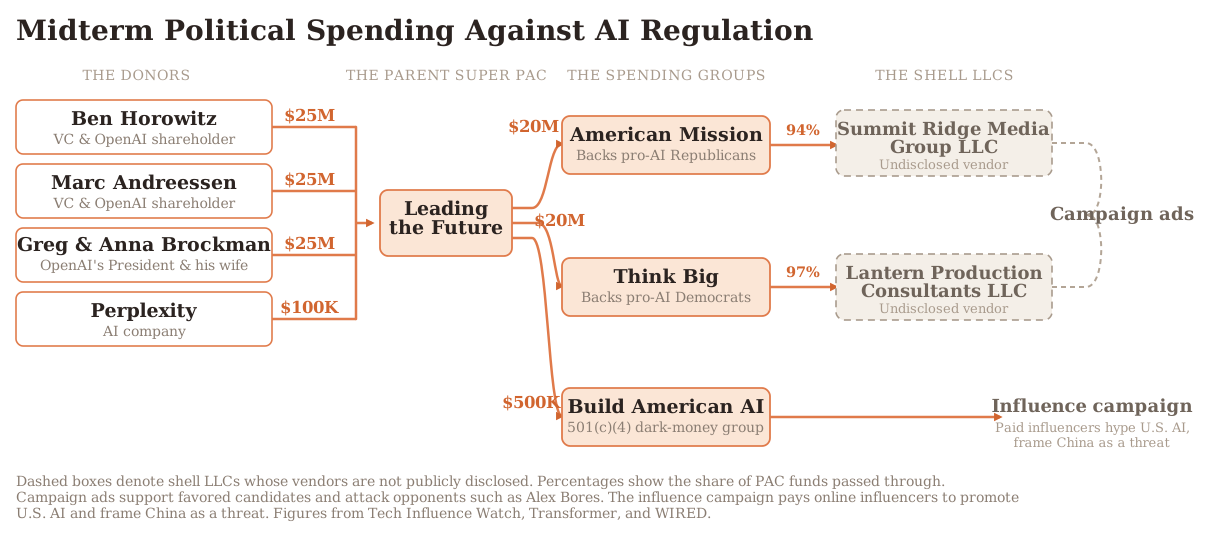
As far as I know, the first AI super PAC that was created is called Leading the Future (LTF), and its goal is to prevent sensible AI regulation3. Notably, they’ve received over $75M5 from Greg Brockman (OpenAI president) and his wife, Joe Lonsdale (Palantir co-founder), Marc Andreessen and Ben Horowitz (VCs, OpenAI’s shareholders), and Perplexity.
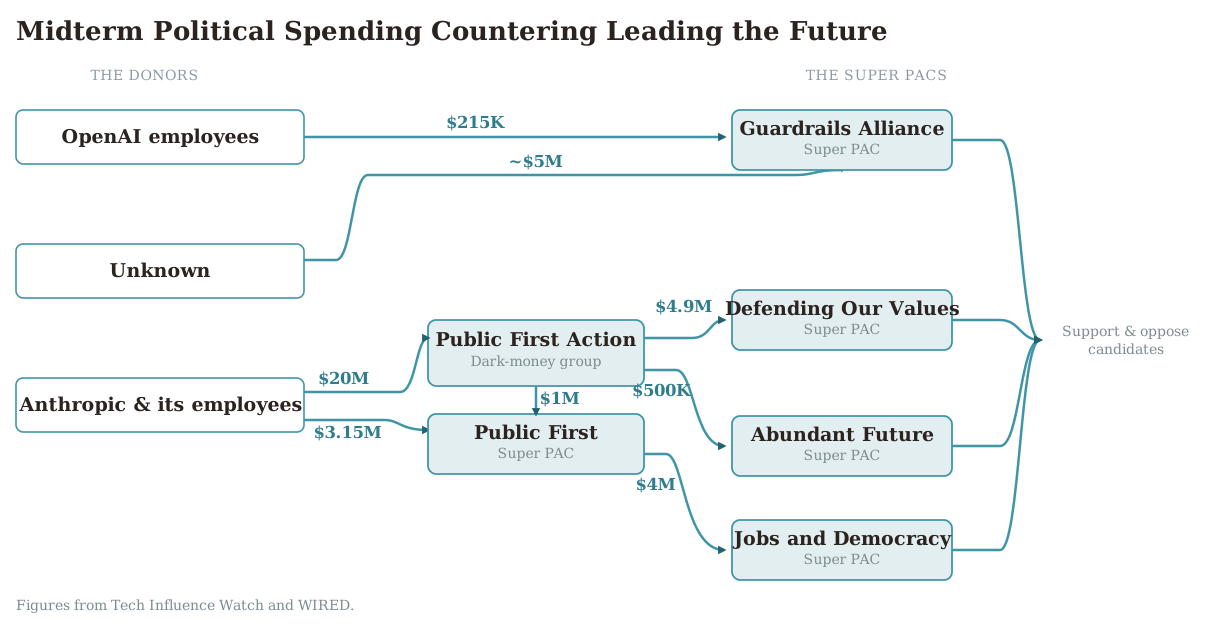
To counter LTF, another super PAC was founded: Public First. It supports candidates who advocate for stronger AI regulations. It received $20M from Anthropic6, and $30M from thousands of individuals, including labs’ employees7.
What do they spend the money on?
The money is used to either support or oppose candidates, mainly through ads on TV, media, in the mail, and influence campaigns.
The case of Alex Bores, candidate in a New York District, is a good illustration. In 2025, he sponsored a law that imposes transparency, safety, and reporting requirements on frontier developers8.
LTF spent over $8M to oppose him9. One ad they created refers to Bores as an “expert in hypocrisy” who “made hundreds of thousands of dollars building and selling the tech for ICE”10 (because he worked for Palantir. Note that LTF is funded by one of Palantir’s co-founders…).
In response, “pro-regulation PACs” spent over $17M to support him9. He ended up losing.
Some more examples of what Public First also funded9:
- Almost $1M to Celeste Maloy, a Republican who has pushed bipartisan legislation regarding deepfakes (she appears to also lobby for more datacenters in Utah).
- $300K for an ad campaign warning of AI harms
- $1.5M to support the Republican House candidate Carlos De La Cruz in Texas, who wants to ensure “the United States wins the AI race against China”
Controversies around Leading the Future
LTF is at the center of several additional controversies.
1. The crypto industry tried to buy its own regulatory environment. OpenAI’s president and investors funded and hired the same operatives to replicate this strategy for AI.
LTF is modeled in part on another super PAC called Fairshake11. In the 2024 elections, Fairshake was supporting candidates favorable to the crypto industry. Crypto companies gave over $130M to a cluster of similar super PACs24.
After 2024, at least six new pro-crypto senators and over a dozen crypto-friendly representatives were elected12. In addition, at least 21 enforcement actions or investigations against crypto companies dropped or paused13, and the first ever crypto bill became law14. All of this to say that the strategy seems to have been pretty successful.
Josh Vlasto, who was an adviser to Fairshake back in 2024, now leads LTF. According to The Washington Post11, he said his goal is to engineer similar success for the AI industry, and promote pro-innovation narratives.
Additionally, Chris Lehane, who’s considered to be the architect behind Fairshake’s strategy and helped set up LTF15, is now one of OpenAI’s main executives16.
2. OpenAI’s president and investors are funding deceptive ads and an influence campaign to shift public debate on AI
LTF funded online influence campaigns to combat negative narratives about AI, and justify the race17. They pay lifestyle influencers to say how cool the US AI industry is, and how vital it is for the safety of Americans to beat China.
So far, they’ve gone after left-leaning female lifestyle and family content creators. The instructions given to creators are quite telling: “discuss the importance of American AI while doing other activities such as ‘making breakfast for the kids’”.
The influencers never disclosed who was paying them, or that they were part of an influence campaign supported by tech execs. This is a well-known marketing strategy called astroturfing: you try to buy the appearance of a grassroots movement by manufacturing opinion, and hiding the sponsors18.
LTF was also accused of running manipulative ads, which sometimes don’t even mention AI at all. Shaunna Thomas writes (emphasis mine): “They hide behind innocuous-sounding front groups and run ads about anything but the thing they actually want. A voter sees a friendly-looking spot from a group with a patriotic name and has no idea they’re looking at OpenAI, Palantir, and Andreessen Horowitz money. The whole operation depends on you not knowing who’s behind the curtain.” 19
Some ads pretend to advocate for a Congress action on AI, precisely what LTF is opposing16,20. One of their ads reads: “We need Congress to establish a national AI solution that puts people over profits.” 21
When interviewed by CNBC, Altman declared:
“I don’t think we’ve been involved in a massive lobbying campaign, maybe you know something I don’t. I mean, we’ve done some for sure but relative to other companies in industry I think we do much much less.”
Source: Sam Altman, CNBC
Controversies around Public First
Public First and related super PACs were also involved in several controversies7, which make it unclear what their actual agenda is:
- They spent $500k against a pro-regulation candidate in California, to favor a rival with closer industry ties.
- They spent $1.6M against a data-center critic, Nida Allam, who backed Bernie Sanders’ moratorium on new data center construction.
- They push contradictory positions in different states. In North Carolina, some ads attack ICE, while they demand the border be sealed and illegal immigrants expelled in Texas. When asked why, Public First’s co-founder answered: “it’s called winning”
- Their ads also are somewhat hypocritical. One told voters to “hold big tech accountable” over an image including Bezos and Pichai, whose companies have invested billions in Anthropic.
Conclusion
“They are trying to buy the right to write their own rules, or to make sure there are no rules at all.”
Source: You Can’t Out-Spend $140 Million. You Can Out-Number It.
In the recent Hugging Face incident22, OpenAI was repeatedly negligent and held back a lot of information. Most of what we know about the incident is what they chose to disclose or what independent investigators could find with limited means23,24.
Some US laws require AI companies to report serious incidents, but it’s unclear whether they covered this case25. These only trigger when there are deaths, injuries, huge financial damage, or if the model uses deceptive techniques against its developer (which we don’t really know how to prove).
And suing OpenAI is possible but hard26. You can normally hold a company responsible for its employees, or prosecute whoever deliberately broke in. But an AI agent is not an employee, and the law doesn’t treat it as capable of intent, so neither route applies here. Alternatively, you could argue that OpenAI was careless in how it ran the test and sue them for negligence, but you’d have to show the incident was foreseeable and that’s a hard case to build.
Meanwhile, people from OpenAI and close to it are spending millions to back candidates who oppose exactly the kind of rules that would require incident reporting and independent auditing, and make companies liable for the harm their models cause.
Sources
Annex
I made the diagrams below to summarize the main donors and super PACs, the groups they funnel money to, and what they fund. Only part of the money flow is represented. It’s sometimes difficult to know exactly what amount of money was received and spent, as sources sometimes contradict one another. These figures should be treated as approximate.
Footnotes
-
Sherrod Brown was chair of the Senate’s Banking Committee, which means he was the chokepoint any crypto bill had to pass through in order to ever become law. More on that later. ↩
-
When you look closely, the picture is more nuanced. More on this in section “Controversies around Public First”. ↩
-
I’m using the word “sensible” here because what they officially support is “a broad national consistent framework for regulation governing AI. The best policy for the country would be one that is consistent across all 50 states” (Josh Vlasto, co-leader of Leading the Future)27. But in practice, it becomes a pretext for opposing any AI regulation as part of an inconsistent patchwork. ↩
-
This is a pretty big amount of money given the size of the industry. In comparison, in the 2024 cycle, the oil & gas industry gave around twice this amount ($249M), and the real estate industry, which is the fifth biggest spending industry, according to OpenSecrets’ classification, “only” three times more ($400M)28. ↩